Service Dog Tasks and the Public Access Test, Explained
This page explains the law in general terms. It is not legal advice. For a specific situation, contact the agency listed on this site or an attorney.
Two questions come up for almost every Arkansas handler who trains a service dog. What counts as a task? And what is the public access test? This guide answers both and walks you through training toward them, step by step.
One point first. The public access test is a training benchmark. It is not a legal requirement under the ADA, and it is not a certificate you must hold. Tasks, on the other hand, are at the center of the legal definition.
What counts as a service dog task under the ADA
According to ADA.gov, a service animal is a dog that is individually trained to do work or perform tasks for a person with a disability. The work or tasks must be directly related to the person's disability.
Arkansas follows the same idea. Ark. Code Ann. 20-14-304 does not write its own definition. It points to the definition of a service dog in Titles II and III of the ADA, as that law read on January 1, 2017. FindLaw warns that its copy of the Arkansas Code may not match the newest text, so check the current statute if the exact wording matters to you.
Two parts of the ADA definition matter most:
- Individually trained. The dog has learned a specific behavior on purpose. A dog that simply happens to be calming is not enough.
- Directly related to the disability. The task must address something the disability makes hard or unsafe.
What tasks can a service dog do?
The list of possible tasks is long, because disabilities vary so much. These are common examples, grouped by type of disability. They show the kind of work that fits the ADA definition. They are not a complete or official list.
Mobility disabilities
- Retrieving dropped items such as keys, a phone or a medication bottle
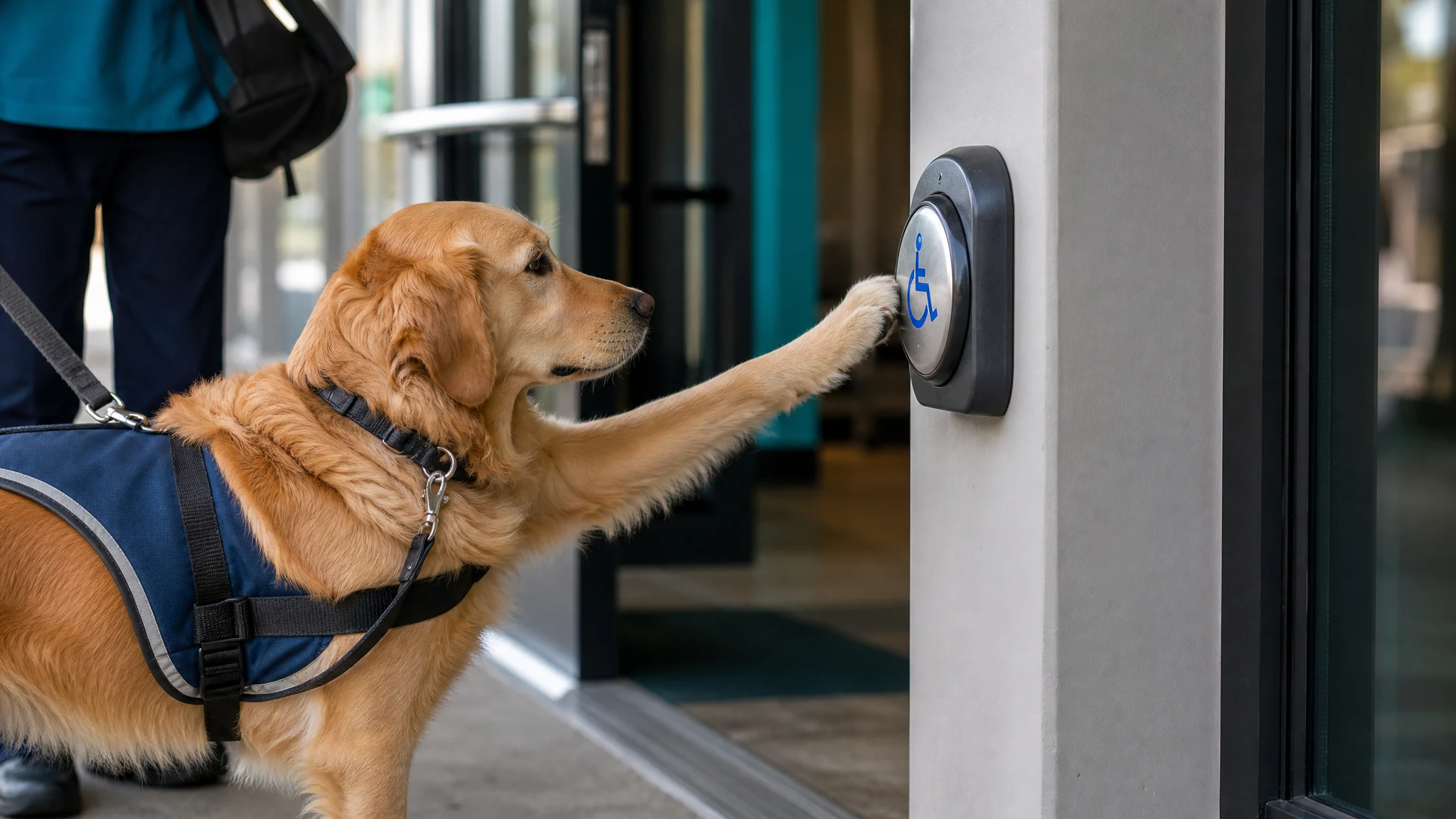
- Opening and closing doors or drawers
- Providing counterbalance or bracing while the handler stands up
- Pulling a manual wheelchair, if the dog is physically suited to it
Hearing and vision disabilities
- Alerting a person who is deaf to a smoke alarm, a doorbell or their name being called
- Guiding a person who is blind around obstacles
- Leading a handler to an exit or a specific location
Medical conditions
- Alerting to a change linked to a condition, such as low blood sugar, when the dog has been trained to do so
- Responding to a seizure by staying with the handler, activating an alert device or fetching help
- Reminding a handler to take medication at set times
Psychiatric and neurological disabilities
- Interrupting repetitive or self-harming behavior
- Turning on lights and checking a room for a handler with PTSD
- Applying deep pressure on cue during a panic episode
- Creating space in a crowd by standing behind or beside the handler on cue
Autism and related needs
- Interrupting a harmful behavior pattern on cue
- Staying with a person who tends to wander, as part of a trained response
Whether a particular behavior is a task depends on the handler's disability and on how the dog was trained. A good habit is to write down each task, the cue or trigger for it, and how it helps with your specific disability.
Why comfort alone is not a task
Many people feel calmer around their dogs. That is real, and it matters. But under the ADA, emotional support, therapy and comfort animals are not service animals. Presence alone, even helpful presence, is not work or a task.
The line is about training and action. A dog that lies beside you because you feel better is giving comfort. A dog that has been trained to apply pressure on cue when it senses your panic starting is performing a task. The second dog may qualify. The first does not.
Arkansas also takes misrepresentation seriously. Under Ark. Code Ann. 20-14-310, an individual may not misrepresent an animal as a service animal, or a service animal-in-training, to a public accommodation. A violator may face a civil penalty of up to $250 per violation, according to FindLaw's copy of the statute.
The public access test: a benchmark, not a legal requirement
Assistance Dogs International (ADI) publishes a public access test that many assistance dog programs use. It checks whether a dog behaves reliably in public: calm, controlled, unobtrusive and under the handler's direction.
It is important to be exact about its status:
- The ADA does not require a service dog to pass the public access test or any other test.
- There is no official service dog registry or required certification under the ADA.
- A certificate or online registration from a seller is not legal proof that a dog is a service animal.
So why use it? Because it gives you a clear, structured way to judge whether your dog is ready for public places. Under the ADA, a business may ask a dog to leave if it is out of control and the handler does not take effective action, or if it is not housebroken. A dog that meets a solid public access standard is much less likely to run into that problem.
For the current official test items and scoring, check with Assistance Dogs International directly. The details can be updated, and this article does not reproduce them.
How to train toward tasks and public access readiness
Materials needed
- A well-fitted flat collar or a harness that does not restrict movement
- A standard leash (a 4 to 6 foot leash works for most practice)
- Small, soft, high-value treats, and a treat pouch
- A clicker or a consistent marker word, if you choose to use one
- A mat or small blanket for settle practice
- A notebook or phone log to track tasks and sessions
- Access to a range of practice locations, built up gradually
All training here is humane and reward-based, in line with the American Veterinary Society of Animal Behavior (AVSAB) position that aversive methods carry welfare risks. Do not use shock, prong or choke collars, alpha rolls, scruffing or any dominance method.
Step 1: Name the tasks you need
Start with your disability, not with a trick list. Write down the specific problems your disability creates. Then match each one to a task the dog could learn. Keep the first list short, with two or three tasks, so you can train each one well.
Step 2: Build the foundation behaviors
Teach sit, down, stay, come when called and a relaxed settle on a mat. Add loose-leash walking and a cue to ignore food on the floor. Reward heavily and keep sessions short, about five minutes. Foundation skills carry over into every task and into every public setting.
Step 3: Teach each task in small pieces
Break each task into steps. For a retrieve, for example, reward looking at the item, then touching it, then picking it up, then holding it, then bringing it to you, then releasing it into your hand. Add the cue only after the dog does the behavior reliably.
For a medical or psychiatric response, work out a clear trigger and a clear cue. Because these tasks carry higher stakes, many handlers choose to work with a qualified trainer. Check any trainer's methods first to make sure they are reward-based.
Step 4: Proof the behavior in new places
Dogs often fail to carry a skill over to a new place. Practice each task in different rooms, then in the yard, then in quiet public spots. Raise the difficulty a little at a time. If the dog struggles, go back to an easier setting rather than pushing through.
Step 5: Add distractions slowly
Introduce sounds, other people, rolling carts, dropped food and other dogs at a distance. Reward calm choices. Your goal is a dog that checks in with you instead of reacting.
Step 6: Practice public manners
Work on the behaviors a public access test typically looks at: walking calmly beside you through crowds, settling under a table or chair, staying put when you stand up, ignoring people who try to pet or call the dog, and entering doorways politely. Also practice calm behavior around food, elevators and traffic. Keep the dog clean and groomed, and keep up toileting routines so accidents stay rare.
Step 7: Run your own mock public access test
Once the dog is steady, ask a friend to watch you move through a store or other public place with the ADI test items in front of them. Have them note anything that goes wrong. Treat the notes as training information, not a pass or fail grade, and return to earlier steps where needed.
Step 8: Know the two questions and your rights
ADA.gov explains that when it is not obvious that a dog is a service animal, staff may ask only two things: whether the dog is a service animal required because of a disability, and what work or task the dog has been trained to perform. Staff may not require documentation, an ID card or a demonstration of the task.
Under Ark. Code Ann. 20-14-304, people with disabilities have the right to be accompanied by a service animal and cannot be charged an extra fee for it. Section 20-14-308 also says a guide, signal or service dog handler may not be refused access to streets, sidewalks, lodging, restaurants and other listed public places because of the dog. The handler is liable for damage the dog does to the premises. For a fuller look at Arkansas rules, read our guide to service dogs in Arkansas, including training, access rights and where to get help.
Tips for better results
- Keep sessions short and frequent. Several brief sessions a day usually work better than one long one.
- Reward what you want to see. Catch the dog being calm in public and pay for it.
- Watch the dog's stress signals. Yawning, lip licking, avoiding or freezing mean the setting is too hard. Move farther away or end the session.
- Keep a task log. Dates, places and success rates help you see progress and decide what to work on next.
- Plan for the dog's health and age. Not every dog is suited to every task or to public work. Retiring or declining a dog from public work is a valid, caring choice.
Common mistakes to avoid
- Calling comfort a task. If the only thing the dog does is be near you, it is not a trained task under the ADA.
- Buying a registration or certificate. It does not prove anything legally, and the ADA does not require it.
- Skipping the foundation. Advanced tasks fall apart without a reliable settle and loose leash.
- Going to busy places too soon. A dog that is overwhelmed learns the wrong lessons.
- Using harsh corrections. Aversive tools and dominance methods can damage trust and increase fear or aggression.
- Treating the public access test as the law. It is a useful standard for readiness. It is not an ADA or Arkansas requirement.
Expected results
Results vary with the dog's temperament, age and health, how complex the tasks are and how consistently you train. Many handlers find that a dog may take many months to reach reliable task performance and public readiness, and some dogs take longer. Some dogs turn out not to suit service work, even with good training.
With patient, reward-based practice, a dog is likely to become steadier in public and more reliable at its tasks. No training plan can promise a particular outcome or timeline.
Where to get help in Arkansas
If you would rather work with a program than train entirely on your own, several Arkansas organizations describe their services on their own sites. Arkansas Service Paws in Ward says it serves veterans, first responders and qualifying dependents living with PTSD at no charge to the client. Mission: Service Dog in Bentonville and Service Dogs of Distinction in Mount Vernon also list programs. Service Dogs of Distinction says it provides dogs and training at no cost to veterans. Saving Grace Service Dogs of Arkansas publishes a fee of $3,000 down and $250 per month until the dog graduates. These are listings, not recommendations. Contact each organization to confirm its current eligibility, costs and waitlist.
Veterans can also look at the VA. The VA does not provide service dogs. It gives veterinary health benefits to veterans prescribed a guide or service dog for a visual, hearing or substantial mobility impairment.
For housing problems involving a service dog, the Arkansas Fair Housing Commission, under the Arkansas Department of Inspector General, handles housing complaints. I found no Arkansas state agency that takes public access complaints about service dogs. Check with the ADA.gov complaint information or an attorney if you are refused access. This article is a plain-language explanation, not legal advice.
Sources
- ADA.gov, Frequently Asked Questions about Service Animals and the ADA
- FindLaw, Arkansas Code 20-14-304
- FindLaw, Arkansas Code 20-14-308
- FindLaw, Arkansas Code 20-14-310
- Arkansas Department of Inspector General, Fair Housing
- VA Prosthetic and Sensory Aids Service, Service and Guide Dogs
- Arkansas Service Paws
- Mission: Service Dog
- Service Dogs of Distinction
- Saving Grace Service Dogs of Arkansas